There’s a simple domestic dilemma hiding in plain sight: should you dry laundry with an asciugatrice (tumble dryer) or on a stendino (rack or line)? It looks like a lifestyle choice. It’s actually a money-and-health question, especially in winter apartments and small homes. We crunched the numbers across bills, minutes, humidity, and hidden wear. The answer isn’t what most people expect.
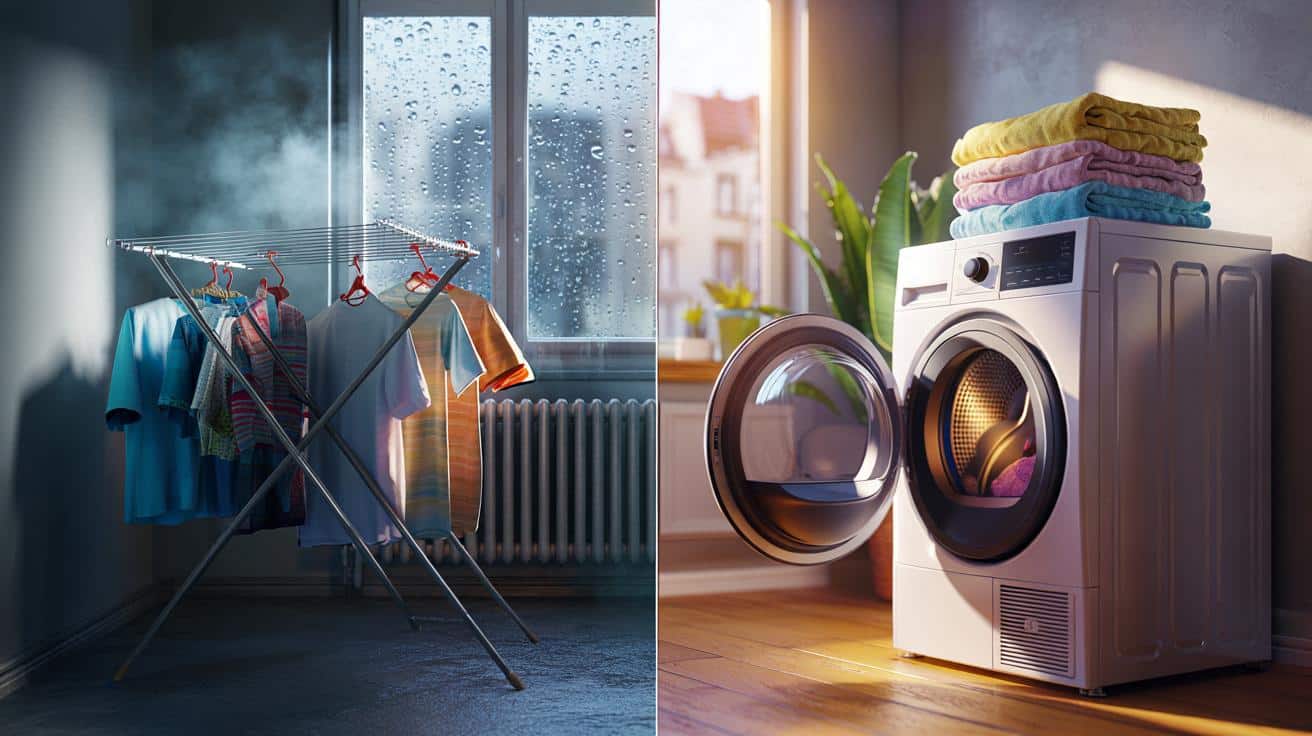
A steel stendino unfolds like an awkward bird over the radiator, shirts hanging by their shoulders, socks pegged in pairs. The air turns sweet and heavy. The hiss of the boiler climbs a notch as two liters of water, quietly exhaled from cotton, drift into the room. In the next building, a soft hum rises: someone’s heat‑pump dryer is spinning, door light blinking like a tiny sun. Money is moving; so is moisture. As the pane fogs, a thought lands with a thud. What actually costs less?
Asciugatrice vs stendino: the numbers that move your bills
Start with a typical load: 5 kg of dry clothes after a 1200 rpm spin still hold about 2–2.5 liters of water. A modern heat‑pump asciugatrice uses around 0.9–1.5 kWh to pull that water out, at an electricity price near €0.25–€0.30/kWh in many European homes. That’s roughly €0.25–€0.45 per load in energy. An older vented or condenser dryer? Think 2.5–4 kWh, or €0.65–€1.20 per load. Line‑dry outside costs almost nothing. Indoors on a stendino in a heated room, the energy that dries your laundry is your space heating. And that changes the math.
How much? Evaporating 2.5 liters of water needs about 1.6 kWh of heat. In a gas‑heated apartment with a condensing boiler, that’s roughly 1.6–1.8 kWh of gas input, maybe €0.15–€0.20 at recent prices. With electric resistance heating it’s closer to €0.40–€0.50. With a heat‑pump for space heating the drying cost shrinks, but the humidity has to be vented, or it clings to walls and window frames. Outside on a breezy day, the sun and wind do the heavy lifting for free. Indoors without heating on, the cost is low, but time drags and condensation grows.
Put it together and you get a seasonal verdict. **In summer or in a dry, windy place, the stendino wins hands down: nearly free, zero noise, great for fabrics.** In a heated winter apartment, a heat‑pump asciugatrice can cost the same or even less than indoor air‑drying once you factor the boiler’s work, plus it spares your walls from excess humidity. Old, energy‑hungry dryers still lose on cost. Yet they may save you two hours and a room full of damp air. The hidden line item isn’t electricity; it’s moisture and time.
Real-life use: small moves that change the outcome
There’s one lever that beats all others: spin speed. If your washer jumps from 1000 to 1400 rpm, residual water can drop by 10–15%. That’s 0.15–0.25 kWh less for a heat‑pump dryer and less steam in your kitchen. It also means faster outside drying because the breeze has less work to do. Pair that with sorting by fabric weight—towels with towels, shirts with shirts—and you shave minutes and wrinkles either way. *It sounds mundane, yet it shapes daily comfort.*
Ventilation is the quiet hero for stendino lovers. Crack a window in short bursts, fifteen minutes at a time, so damp air leaves without draining your heat for hours. Place the rack in a well‑ventilated corridor or by a window, not pressed against radiators where air can’t circulate. Use hangers for shirts to reduce ironing later. And keep a cheap hygrometer nearby: 60% relative humidity is a friendly ceiling for a lived‑in room. Let’s be honest: nobody really does that every day.
Moisture management also protects your home. **If you dry on a rack in a heated room, you’re paying for it through your heating bill.** A small dehumidifier running next to the stendino can use 0.2–0.4 kWh per hour yet speed things up, lower mold risk, and cut window condensation.
“Two liters of water in the air is not a metaphor,” a building inspector told me. “It’s what peels paint.”
- Target: humidity under 60% when drying indoors.
- Trick: spin faster, then hang lighter fabrics separately.
- Swap: consider a heat‑pump dryer if winter loads pile up.
- Health: ventilate in short bursts, not a permanent draft.
The surprise: the winner changes with the weather
Here’s the twist that surprises most households. **On a damp winter week, a modern heat‑pump asciugatrice can be cheaper than air‑drying indoors—and far kinder to your walls and lungs.** In spring sunshine or a dry breeze, the stendino is unbeatable on cost and fabric care, and you’ll iron less. In between, a hybrid rhythm often makes the most sense: use the rack in bright weather, and the dryer when the forecast turns gray and the heating is on. We’ve all had that moment when the living room turns into a laundry forest. The hardest part isn’t the bill. It’s the air you breathe.
| Point clé | Détail | Intérêt pour le lecteur |
|---|---|---|
| Cost per load | Heat‑pump dryer ~€0.25–€0.45; old dryer €0.65–€1.20; indoor stendino piggybacks on heating €0.15–€0.50 | Choose the cheapest path for your season and setup |
| Humidity & health | 2–2.5 L water released per load indoors without venting | Avoid condensation, mold, and stuffy air |
| Time & fabric care | Dryer: 1–2 h; rack: 4–24 h; sun reduces ironing, dryers fluff towels | Match method to your schedule and texture preference |
FAQ :
- Is a heat‑pump dryer really that efficient?Yes. Typical modern models use 0.9–1.5 kWh per cycle for a mid‑size load thanks to closed‑loop heat recovery.
- Does indoor drying always cause mold?No, but repeated high humidity raises the risk. Vent in short bursts and monitor with a hygrometer if you rely on a stendino.
- What about CO₂ emissions?Rough guide: 1 kWh electricity ≈ 200–300 g CO₂ in many grids; gas heating ≈ 180–220 g/kWh. A heat‑pump dryer often equals or beats indoor drying in winter.
- Will higher spin speed damage clothes?Most everyday fabrics tolerate 1200–1400 rpm well. Use gentler cycles for delicates and wool to balance wear and water removal.
- How do appliance costs factor in?Amortized over 1,000–1,500 cycles, a €500 dryer adds roughly €0.33–€0.50 per load. Outdoors or rack drying has no machine depreciation.