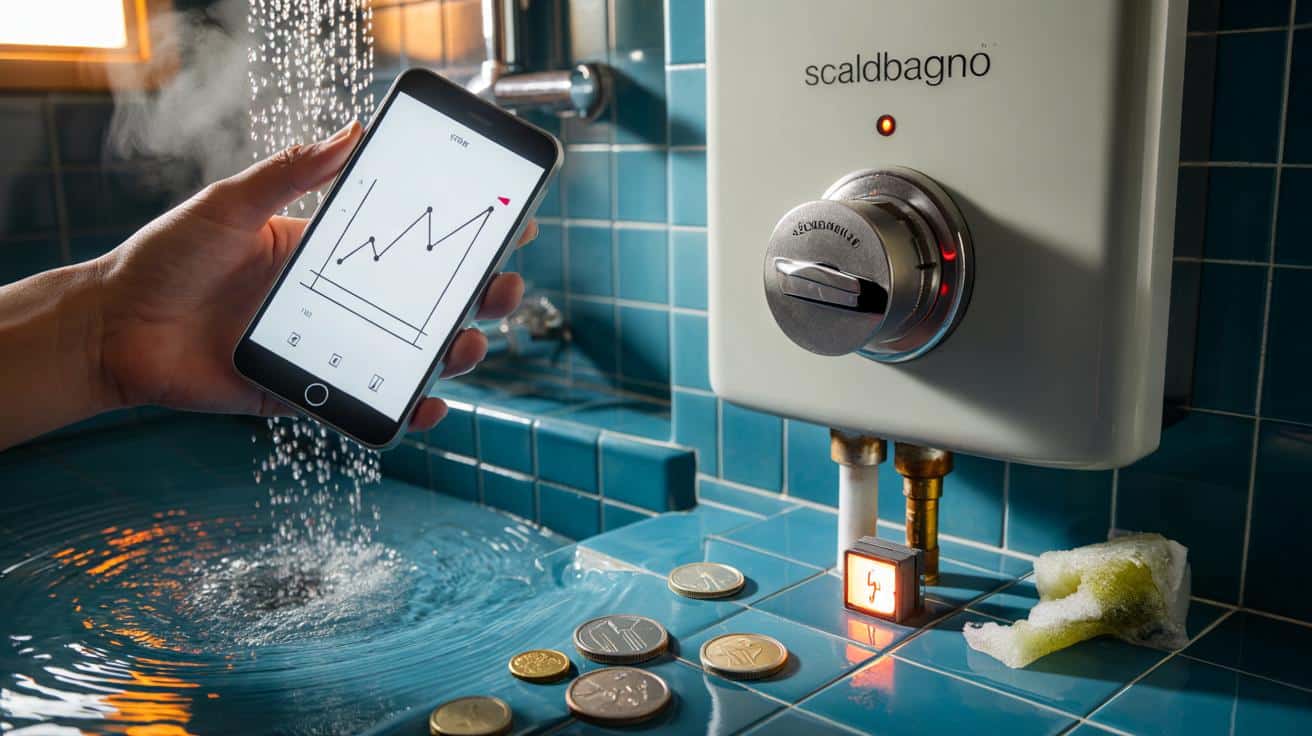
It’s a silent accountant. And tonight, it’s going to show you a number in euros that flips a switch in your head.
The bathroom mirror fogs. Someone shouts “I’m next!” The little red light on the scaldabagno hums like a night watchman. I glance at the energy app and watch the line tick up as the water runs. It’s such an ordinary sound, we stop hearing it. Then a thought hits: how much did that minute of heat just cost? I reach for a notepad, do one line of maths, and my jaw actually drops. You can feel money evaporate in steam when you know the price of a minute. Count to sixty.
The hot-water habit you never priced
We’ve all had that moment when a bill arrives and feels taller than the envelope. Hot water is one of the reasons. A scaldabagno (storage water heater) draws power quietly, not just during showers, but while you sleep and work. It heats, it waits, it leaks heat into the room over hours. The habit isn’t the shower. The habit is not counting.
Let’s put real euros on it. Heating water takes 0.001163 kWh per liter per degree Celsius. A typical 10‑minute shower uses roughly 60 liters of hot water mixed to 40°C, starting from 15°C. That’s a 25°C lift: 60 × 25 × 0.001163 ≈ 1.74 kWh. At €0.30/kWh, that single shower costs about €0.52. Two showers a day? ~€31/month. Add standby losses for an 80‑liter tank—often around 1.2 kWh/day—another €0.36/day, about €11/month. You see where this is heading.
Now the sand under your feet shifts. Without touching your tiles, you can change how your euros drip away. Most people imagine the shower is the whole story. It isn’t. The thermostat setting bloats standby losses. The timer (or lack of one) decides whether you heat at a pricey hour or a cheaper one. The showerhead flow turns minutes into money. *Tonight, the maths is merciless.*
The euro calculation to try tonight
Here’s the 30‑second method that makes you feel the flow in your wallet. Estimate your shower flow: many showerheads are 8–10 L/min. Hot fraction is usually about 60%. Temperature lift is the difference between incoming water and your mix, say 25°C. Cost formula: euros = liters × delta T × 0.001163 × price per kWh. For a 10‑minute shower at 8 L/min with 60% hot: 48 liters hot × 25 × 0.001163 ≈ 1.39 kWh. At €0.30/kWh: ~€0.42. That’s ~€0.04 per minute. If your head is 10 L/min, think ~€0.05–€0.06 per minute. Gas? Multiply kWh by ~€0.09: €0.12–€0.17 per shower.
Now act with your thumb, not a wrench. Set the scaldabagno thermostat down to 50–55°C to cut standby losses and scald risks. Use a cheap plug‑in timer or the unit’s built‑in schedule to heat 60–90 minutes before showers, then switch off. Night tariff? Shift the big heat to the cheaper band, and you shave 20–30% on that chunk alone. If your showerhead doesn’t say “Eco 8 L/min,” swap it—€10 can drop your cost per minute by a third. **A minute shorter is a five‑cent win, every day, forever.**
There are traps, and they’re common. Limescale acts like a winter coat on the heating element and tank walls, adding 10–30% to consumption. Descale yearly in hard‑water areas. Tiny trick: insulate the first meter of hot pipe leaving the tank to slow heat bleed. People also crank the thermostat “just in case,” then forget. **Let’s be honest: nobody really does that every day.** If you share a home, set a family rule: heat window opens, showers happen, heat window closes. It’s a rhythm, not a punishment.
“Once you put a price on a minute of hot water, behavior follows. I’ve seen families cut 15% just by timing heat and swapping a showerhead,” says Luca, a Milan plumber who greets limescale like an old enemy.
- Do the 10‑second math: flow × minutes × 0.001163 × delta T × €/kWh.
- Lower thermostat to 50–55°C; prevent scalding and shrink losses.
- Use a timer: heat before use, not all day.
- Switch to an 8 L/min showerhead; keep the feel, lose the waste.
- Descale annually; hard water quietly steals your money.
What changes when you see the price of a shower
Something flips. You don’t need a lecture, you need a number you can’t unsee. €0.05 per minute. It’s small, then it isn’t. Two people, ten minutes each, every day—€1/day. Thirty days later, €30. Add standby losses and you’re at €40–€45. That’s a dinner out, or a sports pass, or half a train ticket. Suddenly the timer matters. Suddenly shaving two minutes feels like found money, not cold shoulders.
There’s also calm in it. The scaldabagno stops being a mystery heater and becomes a tool you pilot. You choose when to heat. You choose how hot. Gas users see gentler numbers, sure, but the same levers still move the dial: lower temperature, smarter timing, less limescale, gentler flow. **The habit that changes isn’t “no showers.” It’s “no blind heating.”** That’s a habit you can live with, starting tonight.
| Point clé | Détail | Intérêt pour le lecteur |
|---|---|---|
| Cost per minute | ~€0.04–€0.06/min for electric; ~€0.01–€0.02/min for gas | Instant feel for the price of time under the water |
| Standby losses | ~1.0–1.5 kWh/day for an 80 L tank (≈€0.30–€0.45/day) | Shows why thermostat and timing matter even between showers |
| Quick wins tonight | Thermostat 50–55°C, 8 L/min head, heat 60–90 min before use | Simple, low‑cost steps with visible impact on next bill |
FAQ :
- How do I measure my shower flow rate?Fill a 1‑liter jug under the running shower and time it. If it fills in 7 seconds, that’s about 8.6 L/min (60 ÷ 7 × 1 L). Quick, no tools.
- What’s the best temperature to set on my scaldabagno?50–55°C balances comfort, safety, and lower standby losses. If legionella risk worries you, run a weekly heat‑up to 60°C for an hour.
- Is it bad to turn the water heater off daily?For storage electric tanks, using a timer to heat before use is fine. Tanks are designed for cycles. The element prefers fewer, longer heat runs rather than constant reheating.
- What about gas vs electric—how do the euros compare?Gas heat is cheaper per kWh, so a 10‑minute shower might be €0.12–€0.20. Electric is often €0.40–€0.60. The same tactics save in both cases.
- Does limescale really change my bill?Yes. A scaled element and walls can add 10–30% to energy use. In hard‑water zones, descaling yearly pays back fast. You’ll also get hotter water faster.