The sleeves are shorter, the shoulders meaner, the drape gone. A winter staple turned into a child’s jacket in one rinse-and-spin. Somewhere, a nonna would sigh, then smile, then reach for her basin. There’s a way back for many coats that went “lana cotta” by accident. Not magic. Just know‑how and patience.
It happened in a cold kitchen with fogged windows and a ticking radiator. I watched a scarlet coat collapse in on itself like a souffle caught in a draft, the fabric suddenly dense, the hem curling. The owner stood in socks on the tiles, half laughing, half stunned, trying to pretend it was fine. We carried it to the table, and my elderly neighbor leaned in from the doorway with a soft verdict: “Acqua tiepida. Balsamo. E calma.” I filled the basin and waited. She said the fabric remembers.
When lana cotta happens by accident
Wool is a living thing even when it’s in a coat. The fibers swell with water, lock under friction, and cinch tight with heat. One bad cycle turns a wide, swinging silhouette into a rigid, felted board. We’ve all had that moment when something beloved comes out of the wash looking… wrong.
I met a tailor in Turin who keeps a drawer of “learning moments” from clients: cuffs that shrank into bracelets, collars that lost their roll, a pea coat that now fits a teenager. He swears most arrive after the first cold snap. Panic washes are real; so are small recoveries. A London charity shop worker told me they tag at least a dozen boiled-wool mishaps every January, and half of those could have been rescued the same day.
Here’s why recovery is possible—up to a point. Wool is keratin, a protein with tiny scales. Heat, moisture, and agitation make those scales interlock, a process called felting. You can’t “un-felt” in the strict sense, but you can plasticize the fibers and ease them apart. Water at skin temperature opens the cuticles; conditioner or baby shampoo lubricates and relaxes; gentle tension resets size. Think of it as persuading, not forcing. The cloth wants to be smooth again if you give it a path back. You can recover more than you think—if you move slowly.
Nonna’s gentle rescue: the basin, the balm, the breath
Fill a clean basin or tub with lukewarm water, the kind you’d use for a baby’s bath. Stir in a tablespoon of hair conditioner or baby shampoo per liter until the water turns silky. Lay the coat in flat, fully supported, and let it soak 20–30 minutes without poking it around. Lift it like a sleeping cat, press—don’t wring—between towels to remove drips, and set it on a flat surface.
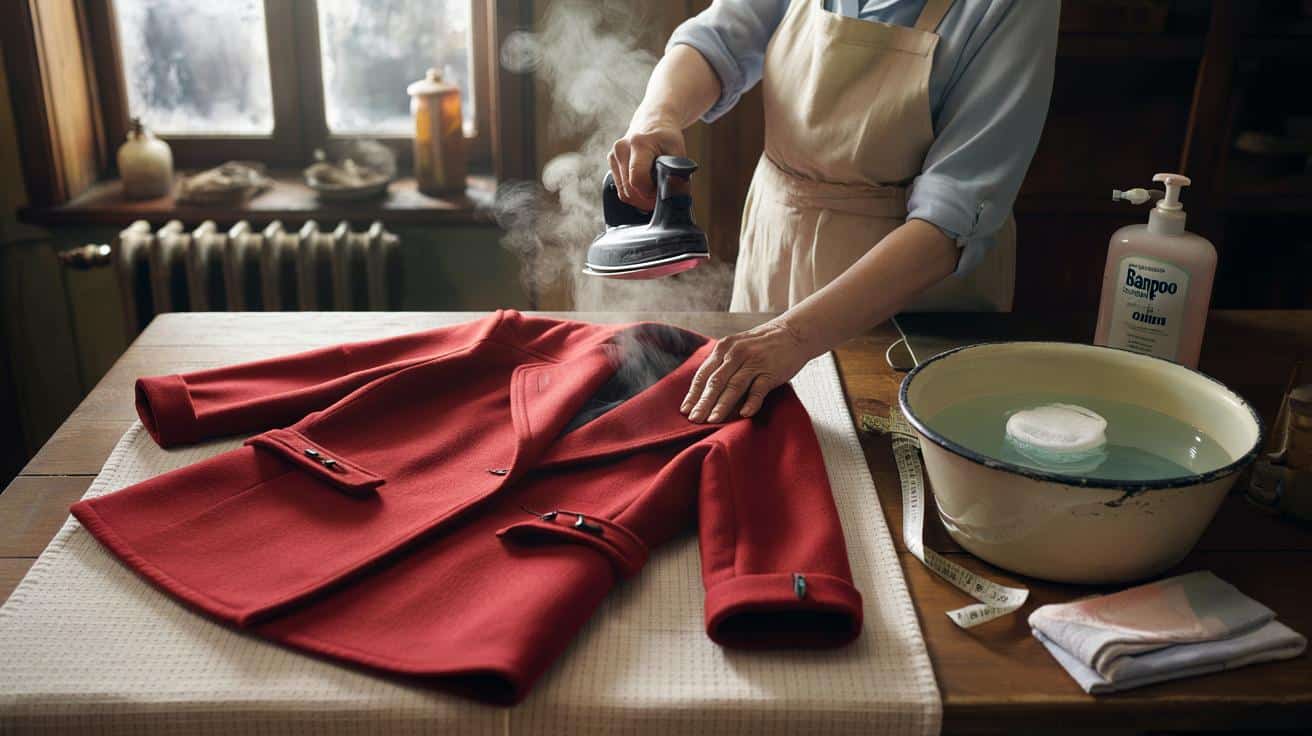
Now reshape. Measure an old photo or a similar coat and aim for those lengths. Work in small sections—shoulders, chest, sleeves—easing the fabric with open palms. Pin the edges along a towel grid or a blocking mat, then hover a steaming iron 1–2 cm above the cloth with a pressing cloth in between. Steam, let the fibers relax, stretch a touch, and let cool. Repeat, inch by inch. Add a splash of white vinegar to the final rinse if you want to brighten the nap and neutralize residue. Let it dry flat, far from radiators. Let it take its time.
Common slips happen when nerves kick in. Pulling hard in one spot can warp the grain. Stretching sleeves lengthwise only can create skinny, too‑long tubes. Don’t shock the coat with very hot or icy water, and don’t hang it wet by the shoulders. If it’s lined, release a few stitches at the hem and armholes so the shell can expand, then re‑tack later. Test colorfastness on a hidden seam before a vinegar rinse. And breathe: you’ll make better decisions when you’re not rushing. Let’s be honest: nobody really does this every day.
Nonna Lucia’s words still echo over the basin.
“La lana ascolta chi non ha fretta.” Wool listens to the one who isn’t in a hurry.
- What you’ll need: basin or tub, hair conditioner/baby shampoo, towels, T‑pins or rust‑proof clips, pressing cloth, steamer or iron with steam, soft tape measure, a photo or reference coat.
- Targets to track: back length, shoulder span, sleeve from crown to cuff, hem sweep.
- Micro‑moves: steam, release, ease, cool. Repeat once more than you think you need.
- When to stop: when the fabric springs back without creasing or protest.
What if it won’t budge? Repair, reinvent, or pass it on
Some coats won’t return to their original size. Dense felting from a full hot cycle, lots of friction, or a low‑quality blend can lock the scales too tight. You can still give it a second life. Consider a new role—cropped jacket, car coat, cape—by working with a tailor who can re‑cut the shape, save the collar, and reuse the buttons. Or keep the fabric: boiled wool makes beautiful mittens, a beanie, even cushion covers that look expensive. What looks ruined can become a story you wear.
There’s a tender kind of practicality in all this. We save a coat, yes, but we also rescue a winter of plans, a stride in the street, a feeling. The basin method isn’t instant, and it won’t fix everything, but it restores agency in a mess that feels irreversible. Share your wins with a friend who’s staring at a shrunken sleeve. Pass the trick to someone moving into their first apartment with a new washing machine and bravado. And if you do nothing else, run your hand across your wool pieces tonight and learn how they’re supposed to feel. That way, the next time the laundry sings its siren song, you’ll answer with a basin instead of a spin. Pulling hard is what felted it; patience is what un‑felts what can be saved.
| Point clé | Détail | Intérêt pour le lecteur |
|---|---|---|
| Soak and relax | Lukewarm bath with hair conditioner or baby shampoo, 20–30 minutes | Gently softens fibers so size can be coaxed back |
| Stretch and block | Pin to measurements, hover‑steam, ease section by section | Recovers shape without tearing seams or warping grain |
| Care going forward | Air out, brush, cold hand‑wash or trusted dry cleaner; avoid shocks | Prevents the next “lana cotta” moment and keeps wool glossy |
FAQ :
- Can you truly “unshrink” a wool coat?Not in a literal sense, but you can often regain 1–2 sizes in width and several centimeters in length by relaxing the fibers, then blocking to shape.
- Is hair conditioner safe for high‑end wool?Yes if used dilute in lukewarm water and rinsed lightly. Choose a simple, silicone‑light conditioner and test on a hidden seam first.
- What water temperature should I use?Think skin‑warm, around 30°C. Too hot tightens the scales; too cold fails to open them. Consistency matters more than an exact number.
- Can I use a dryer or direct iron contact to speed things up?No. Heat plus agitation is how the coat shrank. Steam from a short distance with a pressing cloth; let time do the rest.
- When should I call a pro?If the coat is heavily felted, lined with fused interfacings, or designer‑made, talk to a reputable cleaner or tailor. They can block on forms, adjust seams, or re‑cut with respect for the fabric.