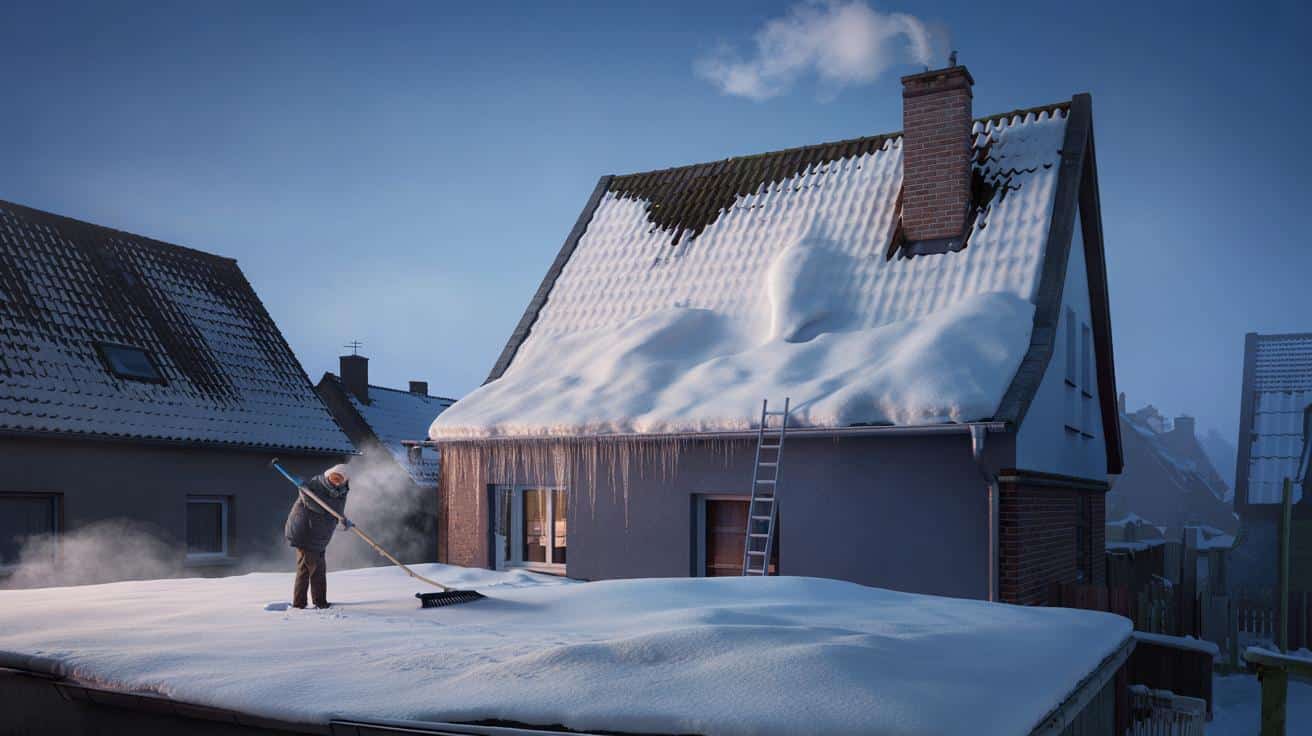
Snow on the roof looks harmless from the street. Soft, white, comforting. Yet up there it gathers weight hour after hour, shifting with wind and thaw, pushing on wood, nails, tiles, and steel. The question isn’t if it weighs something. It’s when that weight starts to threaten the house you live in.
Streets muffled, chimneys breathing, gutters groaning in that low way you only catch when you step outside alone. The neighbor, Lorenzo, leans a ladder against his eaves, pauses, and listens like a doctor checking a pulse.
From the curb the roof looks beautiful. On the shingles, the snow tells a different story: a thick quilt at the ridge, skinny near a vent, a hard crust where yesterday’s sun glazed the surface. You feel the cold on your cheeks and that small nagging thought behind the eyes.
The attic door gives a sticky nudge. A faint crack threads across the paint above a doorway that wasn’t there yesterday. You hold your breath in the quiet, weighing the choices. *The silence doesn’t feel friendly.*
When snow on your roof turns from postcard to problem
Not all snow is created equal. The risk rises with weight, and weight comes down to density, drift, and freeze–thaw cycles more than simple depth. A light, sugary 30 centimeters can sit up there like a duvet, while the same depth of sticky, waterlogged snow presses like a soaked wool coat.
Wind shapes the danger too. It scours one side and piles the other, building a drift that can double or triple the load in one zone. The eye sees “even white,” the structure feels uneven stress. That’s why a harmless-looking ridge can hide a problem no one notices until beams complain.
Numbers help, even if they’re broad. Fresh powder often weighs roughly 50–100 kg per cubic meter; wet spring snow can hit 200–300; refrozen crusts and ice go higher. Stack 30 cm of wet snow and you’re near 60–90 kg per square meter. On flat or low-slope roofs, where snow sits and soaks, that’s a meaningful push on rafters, trusses, and connections. **Wet snow is heavy.** The math is simple, the outcomes aren’t.
Real-world signals and the math you can feel
Think of a typical street in a mid-altitude town. Three houses, three roofs, three different stories. The steep clay tiles look clean by noon because snow slides off; the low-pitch bitumen roof keeps its blanket; the metal standing-seam roof is half bare, half drifted. Same storm, wildly different loads. A shallow, shaded valley where two roofs meet can hold as much weight as a small car.
Records show it, too. Municipal reports after big winters regularly list collapses clustered around flat roofs and older barns with long spans. Often it’s not a gentle blanket but a drift pressed by wind against a parapet. Sometimes 20–25 cm of wet snow after a thaw day is enough to rattle a weak link. **Drifts are the real wildcard.** They don’t announce themselves with depth; they announce with pressure.
How does that pressure translate through your home? Gravity pushes down on the roofing, then the sheathing, then rafters or trusses, then into the load-bearing walls and across to the foundation. Any asymmetry—snow only on one side, ice locked over one eave—twists that path. That’s when doors start sticking, drywall hairlines appear, and you hear odd pops at night as wood fibers talk to each other. The snow didn’t suddenly turn evil. The structure is asking for balance.
What to do today: clear smart, check signs, prevent tomorrow’s ice
If you can reach safely from the ground, use a roof rake with a telescopic handle. Pull snow down in thin layers, working from the eave upward, never upward into the shingles. Clear evenly left to right to avoid lopsided loads. Leave a thin cushion—about 5 cm—so you don’t scrape the protective granules or lift edges.
Skip the heroics. Don’t climb a slick roof. Don’t chip ice with metal tools. Don’t clear only one side because it’s easier; that’s how you twist a frame. Keep downspouts open, and move the shoveled snow away from the foundation, not into it. We’ve all had that moment when the quick fix feels good. Let it pass. Let’s be honest: nobody really rakes a roof every day, and that’s okay—target the big storms and the warm-thaw-then-freeze days.
When in doubt, listen and look. New cracks, new sags, new sounds are data. If something feels off, step back and call a pro before you climb a ladder. **Even distribution matters.**
“Snow load is about density and distribution, not depth. A little wet, drifted snow in the wrong corner outweighs a deep layer of powder spread evenly across the whole roof.” — Marta R., structural engineer
- Quick-check: doors that suddenly rub, ceiling lines that bow, or nail pops you can spot in the attic.
- Look for ice-dam ridges along the eaves and water staining at the top of interior walls.
- From the ground, scan for gutter sag, uneven snow melt patterns, and deep drifts around chimneys or parapets.
- After each storm, check that attic vents breathe and that bathroom fans vent outside, not into the attic.
The longer view: design, habit, and the winter we’re living through
Clearing snow is a single act; resilience is a habit. Insulate the attic floor to keep heat in the rooms where you want it and out of the roof deck where it can cook ice dams. Vent the attic so cold air moves, reducing melt–freeze cycles that glue ice to eaves. If your roof is near end-of-life, talk with a roofer about underlayment that resists water at the edges, snow guards on metal roofs, and small design tweaks that break up drift zones. Climate is shifting, storms are weird, and roofs built twenty years ago meet today’s snow in new ways. A little attention between storms pays off when the sky goes quiet and the house starts whispering again.
| Point clé | Détail | Intérêt pour le lecteur |
|---|---|---|
| Snow weight isn’t just depth | Density, drift, and freeze–thaw cycles decide the real load, not the ruler | Helps you judge risk on sight instead of waiting for trouble |
| Clear safely and evenly | Roof rake from the ground, thin layers, leave 5 cm cushion, avoid one-sided clearing | Reduces collapse risk without damaging shingles or twisting the frame |
| Prevent ice dams | Improve attic insulation and ventilation, manage warm air leaks, consider edge underlayment | Keeps water out of walls and ceilings, lowers emergency calls and repair bills |
FAQ :
- How much snow is “too much” for a typical roof?There’s no single depth. Roughly 30 cm of wet snow can press 60–90 kg per square meter, which strains older, flat, or lightly framed roofs. Watch drifts; they can multiply loads in one spot.
- Should I remove all the snow down to bare shingles?No. Leave a thin layer—about 5 cm—to protect the surface. Rake in passes, working from the eave upward, and keep the clearing even across the width of the roof.
- What are the red flags that mean “call a pro now”?Sudden interior cracks, sagging ceilings, doors that won’t close, loud creaks or pops, or a roof that bows unevenly. If you see these, step away and bring in a contractor or engineer.
- Are ice dams a structural risk or just a leak risk?Mostly leak risk, but leaks are serious. Water backing under shingles can soak insulation, rot wood, and mold drywall. Long term, that weakens the roof edge and shortens its life.
- What about flat roofs on porches or extensions?They’re more vulnerable because snow stays put and can absorb rain. Clear them sooner, watch for ponding, and consider professional removal when snow turns slushy or drifts build against walls.