When a Christmas tree goes up in a home with a cat, it’s not just decoration—it’s an obstacle course with flashing rewards. Between the dangling baubles and the glitter that whispers “touch me,” the risk isn’t cute; it’s real. Cuts, poisoning, choking: three holiday guests no one invited. If you’ve got a cat, some ornaments simply don’t belong on your tree.
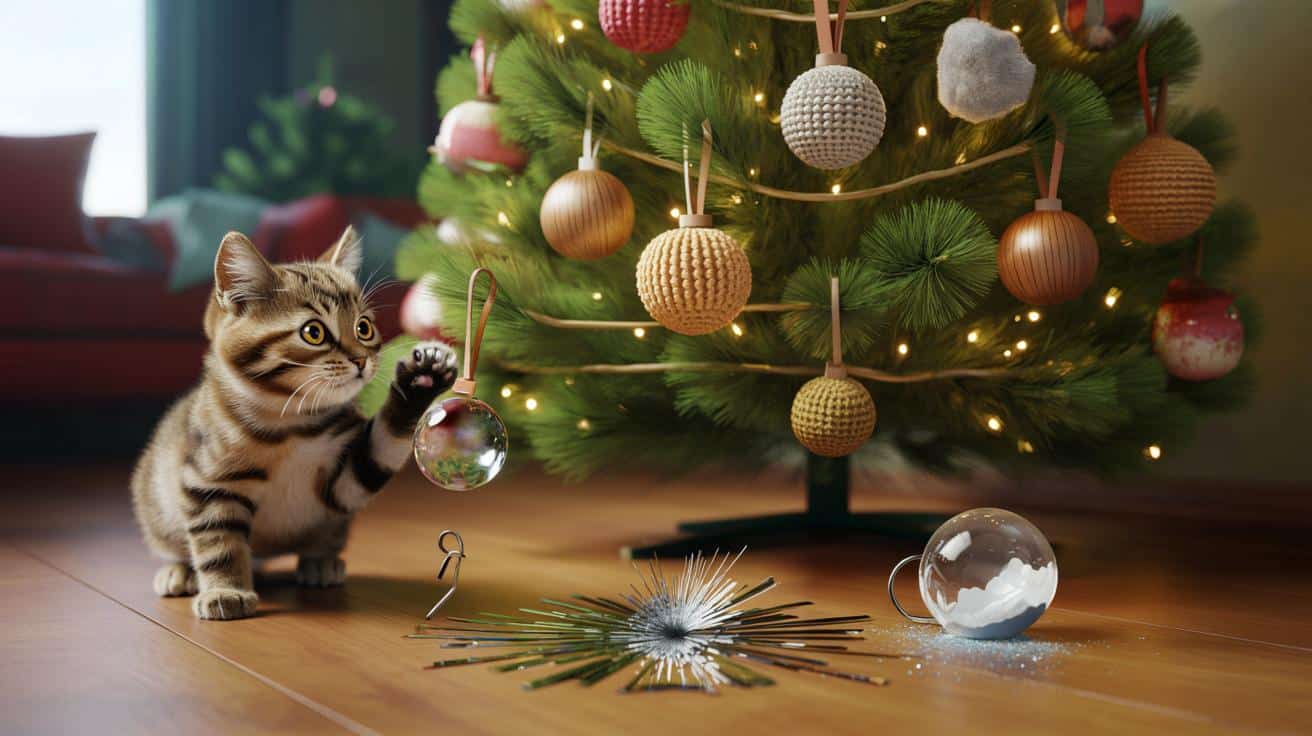
She crouched, eyes dilated, tail swishing in a slow metronome, then leapt—one perfect arc—batting the ornament off a lower branch. It hit the hardwood and exploded into glass snow. Miso froze. Everyone else moved at once.
There’s a hush that follows the sound of breaking in December. Adults shuffle in socks, hands out, whispering “don’t move” as if the cat understands. There’s a broom, a shoebox, a nervous laugh. The air smells like pine and adrenaline. *Cats read your decorations like a puzzle to solve.*
One minute of sparkle can spiral into a night at the emergency vet. And it happens fast.
The baubles that put your cat at risk
Some ornaments are accidents waiting to happen. **Avoid glass baubles.** Thin glass shatters into razor confetti that slices paws and tongues, and fractured edges stick in carpet like landmines. Glittered balls shed micro-particles a cat licks off fur during grooming, which can irritate the gut. Anything with loose caps, tinkly bells, or hanging tassels becomes irresistible prey. The higher the jingle, the faster the pounce. Even “shatter-resistant” doesn’t mean unbreakable when it hits tile at speed. Think physics, not marketing.
There’s a quieter threat: salt dough ornaments. They look innocent—baked, handmade, nostalgic—but one lick can be dangerous. Salt toxicity in cats can trigger vomiting, lethargy, and seizures. Then there are mini snow-globe baubles; some contain antifreeze (ethylene glycol), and if they crack, even a sip is catastrophic. A groomer told me about a kitten who chewed off a metal hook from a red ball and needed surgery to remove it. **Ditch metal hooks.** They’re tiny fishhooks in festive disguise.
The pattern is simple once you see it. Anything that breaks into sharp bits, fits inside a cat’s mouth, or coats their fur with residue is a risk. Most “fun” features for humans—sparkle, jingle, feathers, string—look like prey features to felines. Cats hunt with teeth and paws. Ornaments respond with shards, threads, and chemicals. Not a fair fight.
Safer swaps and smarter setups
Think in layers: safe materials, smarter placement, solid attachment. Swap fragile balls for felt, fabric, crochet, silicone, or unfinished wood. Heavier, matte textures are less hypnotic than glitter. Use ribbon or cord loops instead of metal hooks, and cinch a tiny knot so the loop won’t slide. Place all ornaments—especially round ones—from the mid-branch up, leaving the bottom third of the tree almost bare or decorated with soft, oversized felt shapes. Anchor the tree with fishing line to a wall hook. It looks ridiculous while you do it. It looks brilliant when the cat tests gravity.
Let’s be honest: nobody does this every day. Still, a quick morning “ornament check” after the night zoomies catches half the trouble. Look for loose caps, chewed ribbon tails, and anything on the floor. Skip edible decorations like popcorn chains or dried oranges—delicious, and therefore doomed. If your cat is a climber, a short, sturdy tree beats a tall wobbly one. A quick spritz of pet-safe bitter spray on lower branches can add a nudge of “nope.” Offer a decoy: a cat grass pot or a crinkly toy near the tree base to siphon curiosity.
Here’s the heart of it: your cat isn’t being “naughty.” They’re being a cat. Curiosity plus hanging objects equals game on. A vet once told me,
“If it dangles, it’s designed for a paw—your job is to make the result boring.”
- Skip: glass, thin plastic that cracks, glitter-heavy balls, salt-dough, feathered or stringy trims, mini snow globes, metal hooks.
- Choose: felt, crochet, knitted, silicone, paper honeycomb, solid wood, soft plush.
- Place: safer ornaments up high, bigger soft shapes lower, nothing on the bottom branches that swings.
- Secure: ribbon loops, tight caps, a tree anchor, and a weighted base.
A season that still sparkles—minus the vet bill
You don’t need a sterile, kid’s-craft tree to be cat-safe. You need intention. Pick a colour story or theme—Nordic neutrals, candy-bright, vintage wood—and build it with tactile, thoughtful pieces. Rotate just a few “special” ornaments to a mantle garland or a glass cloche instead of the tree. A strand of warm-white LEDs woven deep into branches adds glow without inviting a swat. Keep a small “trophy” bowl for the baubles your cat inevitably steals; it turns mischief into a private joke instead of a panic. We’ve all had that moment when the living room goes quiet and you know something is up. Let that silence end in a smile, not a scramble.
| Point clé | Détail | Intérêt pour le lecteur |
|---|---|---|
| — | Glass, glitter, salt dough, mini snow globes, and metal hooks are high-risk. | Spot the danger fast and avoid emergency vet visits. |
| — | Swap to felt, crochet, silicone, wood, and paper honeycomb baubles. | Keep the look festive while cutting the risk. |
| — | Place ornaments higher, use ribbon loops, and anchor the tree. | Reduce breakage, chewing, and climbing drama. |
FAQ :
- Which Christmas baubles are the most dangerous for cats?Anything that shatters or sheds: thin glass, brittle plastic, heavy glitter, salt-dough ornaments, and mini snow-globe baubles. Hooks are a hazard too—swap for ribbon loops.
- Are “shatterproof” ornaments truly safe?Safer, not safe. Many still crack into sharp edges. Choose soft materials like felt, crochet, silicone, or wood, and hang them higher on the tree.
- My cat chews ribbon and string—what can I use instead?Choose short, flat fabric loops trimmed close, or use elastic cord cut so it doesn’t dangle. Avoid tinsel, curling ribbon, and tassels altogether. **Skip salt-dough ornaments.**
- How can I stop my cat from climbing the tree?Anchor the tree to a wall, use a weighted base, and leave the bottom branches sparse. Offer a nearby decoy toy or cat grass. A light spritz of pet-safe bitter spray on lower branches can help.
- What should I do if my cat breaks an ornament or swallows a piece?Clear everyone away, sweep and vacuum thoroughly, and check paws and mouth for cuts. If you suspect ingestion—especially glass, hooks, or antifreeze from a globe—call your vet or a poison helpline immediately.