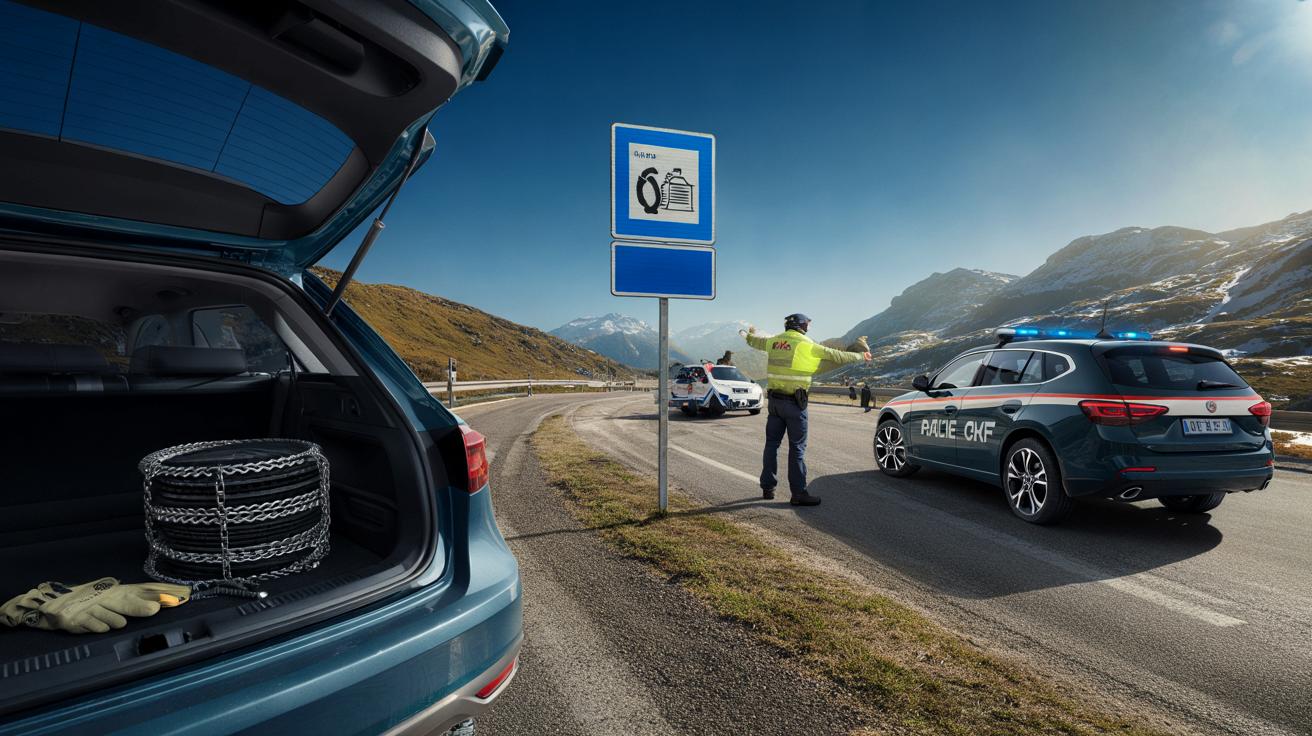
A blue sky, a dry road, and a fine that feels like it came out of nowhere. In Italy, the “obbligo catene a bordo” rule doesn’t look at the weather app. It looks at the sign. And that sign means you can be ticketed even when the asphalt is warm and the mountains shine.
No snow. No sleet. The kind of day you’d swear spring had arrived early. They waved two cars to the side. A brief chat, a polite nod, and then the unmistakable tilt of a fine being written.
The driver blinked at the officer, then at the sky, as if the clouds might answer for him. The officer simply pointed at the blue road sign we’d all driven past without blinking: “obbligo di catene a bordo o pneumatici invernali.” The rule was on. The season was on. The weather didn’t matter.
Then the blue lights flicked on again.
When the sign outranks the weather
Italy’s winter kit rule is as literal as it sounds: carry snow chains on board or fit winter-approved tires, in the period stated, on the roads that say so. The sign is the story. On those stretches, the sanction can hit even in full sunshine, because the obligation is seasonal and location-based, not cloud-based. Think motorway corridors like the A22 Modena–Brennero, the A24 and A25 toward Abruzzo, alpine statals like the SS36 to Valtellina, and long lists of ANAS-managed roads published every autumn.
We’ve all had that moment when you start a trip in the city in light sneakers and hit a shady mountain bend that still remembers January. That’s why the rule lives on specific roads and dates. From the Valle d’Aosta to Friuli, many provinces activate it roughly **from 15 November to 15 April**, sometimes earlier or longer in high valleys. Milan’s metropolitan ring has a winter ordinance too. Rome’s A90 ring often follows ANAS timing. The patchwork sounds confusing, yet the blue sign fixes it in the moment.
The logic is safety as infrastructure, not improvisation. A road manager can’t re-legislate with every cloud. So they set a window when ice and sudden snow are plausible on their kilometers. Article 6 of the Codice della Strada lets them do it. Fail to comply on extra-urban roads and motorways and you’re looking at a monetary hit in the typical range used for these ordinances, plus the real sting: you can be told to stop there and then until you equip. Inside towns, local police apply the urban scale. Sun or not, the rule stands where the sign stands.
How to read, plan, and avoid the sunny-day fine
Start with the sign. The rectangular blue one with a tire and chain icon, sometimes with dates or a “dal 15/11 al 15/04” line, means carry chains on board or run winter-approved tires on that road during that window. Read the subpanel: it can list specific kilometers, bridges, or passes. If you’re on the A22, A27, A32, or the SS26 in Valle d’Aosta, assume a winter window. Better habit: before you leave, check ANAS’s regional lists and your motorway operator’s site for active ordinances. One glance now saves a shoulder stop later.
Gear that counts is simple. Winter tires with M+S marking (Mud+Snow), ideally with the 3PMSF snowflake, are valid for the rule. All-season tires with M+S qualify too. Chains must be homologated (UNI 11313 or equivalent) and sized for your tire. They must sit in the car, reachable, not at home in the cellar. Two pairs only if your vehicle’s manual asks for it. Soyons honnêtes : personne ne fait vraiment ça tous les jours. So pack once for the season and leave the kit in the boot.
“The sunshine doesn’t suspend the ordinance,” a highway officer told me near Vipiteno. “If the sign is active, we enforce it. We can’t wait for the first flake to decide.”
- Read the blue sign: It governs that stretch, that day.
- Check dates: Many roads run mid-November to mid-April, with alpine extensions.
- Carry real chains: Certified, the right size, not plastic “emergency” toys.
- All-season M+S works: Still, ice favors true winter compounds.
Where the fine bites even in full sun
Picture a quiet late-March morning on the SS36 coming out of Lecco, lake glinting like a postcard. The blue sign appears just past the tunnel. A driver with summer tires and no chains onboard is technically in breach for that signed segment, even if the day feels like June. On the A24 Roma–L’Aquila, a dry lane can hide a shadowed viaduct still at freezer temps. The patrols know where ice lives, and those are the kilometers you’ll see the ordinance return every year.
Another common trap: crossing regional borders. Piedmont’s provincial roads into the Langhe get sunny afternoons, then snap-frozen dawns. The same day, Trentino’s SR 49 through Val Pusteria switches microclimates three times before lunch. On the A32 to Bardonecchia, in March, skiers drive under cobalt skies and still get pulled for noncompliant tires. The road manager’s seasonal sign bridges those swings, so drivers don’t gamble with physics at 110 km/h.
Fines follow the framework of the Codice della Strada. On extra-urban and motorway stretches under Article 6 ordinances, expect the higher bracket typically used for noncompliance, and the possibility you’ll be told to halt until you fit chains or turn back. Inside municipalities under Article 7, the urban range applies. Amounts vary per update and zone. What doesn’t vary: the right to stop you even when the tarmac looks perfect. *Winter rules travel with you, not with the clouds.*
There’s also the “soft” penalty: time. Being waved to the shoulder and unpacking chains beside a guardrail is nobody’s idea of a Saturday. A ten-minute check before departure beats a one-hour roadside fix with cold fingers. If you rent a car, ask for M+S tires in winter months in northern regions, especially on airport pickups bound for ski areas. The counter staff know the drill. Sometimes they’ll include chains in the trunk for cross-border trips into Austria or France, where rules are similar yet not identical.
Drivers of SUVs and EVs face a different trap. Heavy vehicles with wide tires can’t always accept traditional chains. Your manual will say “chains prohibited” or specify low-profile devices. There are textile “socks” and special nets homologated for Italy. They’re legal only if certified under the right standard. Don’t guess on the forecourt. Check your manual, then buy the exact device that matches your tire size and restriction. A screenshot of the page lives on my phone, and it’s saved me twice.
Some places tighten the calendar. The Valle d’Aosta often runs the rule from 15 October to 30 April on core routes. Dolomites passes get ad-hoc extensions when cold snaps linger. And a quirk: in sudden snow, police can ask any car to fit chains even outside those dates if safety demands it. That’s rare. The everyday reality is simpler: if the blue sign is active, the rule is active. If it’s not there, you’re free to ride the sun.
People ask why the law can’t be smarter, weather by weather. The brutal answer is that roads don’t change law as fast as clouds change shape. Rules like “obbligo di catene a bordo” exist so what’s risky in the shadows doesn’t become tragic at speed. Think of it as a contract between the road operator and you. They declare the season, you carry the kit, and together you buy a margin of safety. **Even in full sun**, mountains write their own scripts.
There’s an everyday rhythm that makes this easy. One plastic box in the trunk all winter. A glance at the rim markings to confirm M+S if you run all-season tires. A mental map of where the blue signs live on your usual route. Let’s be honest: nobody really does that every day. Build small habits, and the odds swing in your favour.
Talk to locals too. Baristas in Canazei know more about pass closures than a week of press releases. Truckers on the A27 can tell you which viaducts stay frosty. The best armor is information plus a simple, ready kit. The fine is the stick. The smoother winter drive is the carrot.
Sunlight can trick us into thinking risk has packed up and gone south. It hasn’t. The rule isn’t a trap; it’s a promise that when winter bites, the road won’t turn into roulette. Share this with the friend who swears “it never snows anymore,” and with the cousin headed to the Alps on Easter. The sky may be blue. The ordinance may still be on. The question isn’t whether you agree with it. It’s whether you’re ready to sail past the blue sign like you belong there.
| Point clé | Détail | Intérêt pour le lecteur |
|---|---|---|
| Seasonal obligation | Applies on signed roads within stated dates | Know when a sunny-day fine can hit |
| Valid equipment | M+S winter or all-season tires, or certified chains | Choose gear that passes roadside checks |
| Sanction scope | Fine ranges differ urban vs. extra-urban; you may be stopped | Avoid delays and unexpected costs |
FAQ :
- Does the obligation apply only when it snows?No. If the blue sign and dates are active, the rule applies even in clear weather.
- Are all-season tires enough?Yes if they carry M+S marking. The 3PMSF snowflake brings better cold grip and is widely recommended.
- What counts as “chains on board”?Homologated chains sized to your tires, reachable in the car, typically one pair for the drive axle unless your manual says otherwise.
- How much is the fine?Amounts vary by road type and local ordinance. Extra-urban and motorways use the higher bracket; urban roads use the urban bracket. Officers can also stop you until compliant.
- Which roads are most affected?A22 Modena–Brennero, A24/A25, A27, A32, and many ANAS statals like SS36, SS26, and alpine valleys often carry seasonal ordinances.