All winter long, millions of radiators hum under windows while their little plastic heads sit stubbornly on “3”. It looks sensible. It feels like the middle. Yet that middle setting quietly wastes heat in some rooms and underserves others. Your boiler works harder than it should. Comfort yo-yos. Bills creep up. The culprit isn’t the technology. It’s that we use valvole termostatiche like on/off switches, not like the smart, room-by-room instruments they are.
A chill ran through the kitchen, kettle hissing, as he glanced at the dial set to 3 and shrugged. “It’s fine,” he said. “It always sits there.” The window caught a weak sunbeam, the kind that warms the plant on the sill but not your feet. Twenty minutes later, the living room felt stuffy while the hallway stayed icy. We’ve all lived that moment where one room is a sauna and another steals your scarf.
He twisted to 5, hoping to “boost” the heat, then back to 3 in guilt. The valve clicked, the boiler sighed, the dance continued. One small number held too much faith. And that’s the quiet trap.
Leaving the valve on 3: the comfy myth that leaks comfort
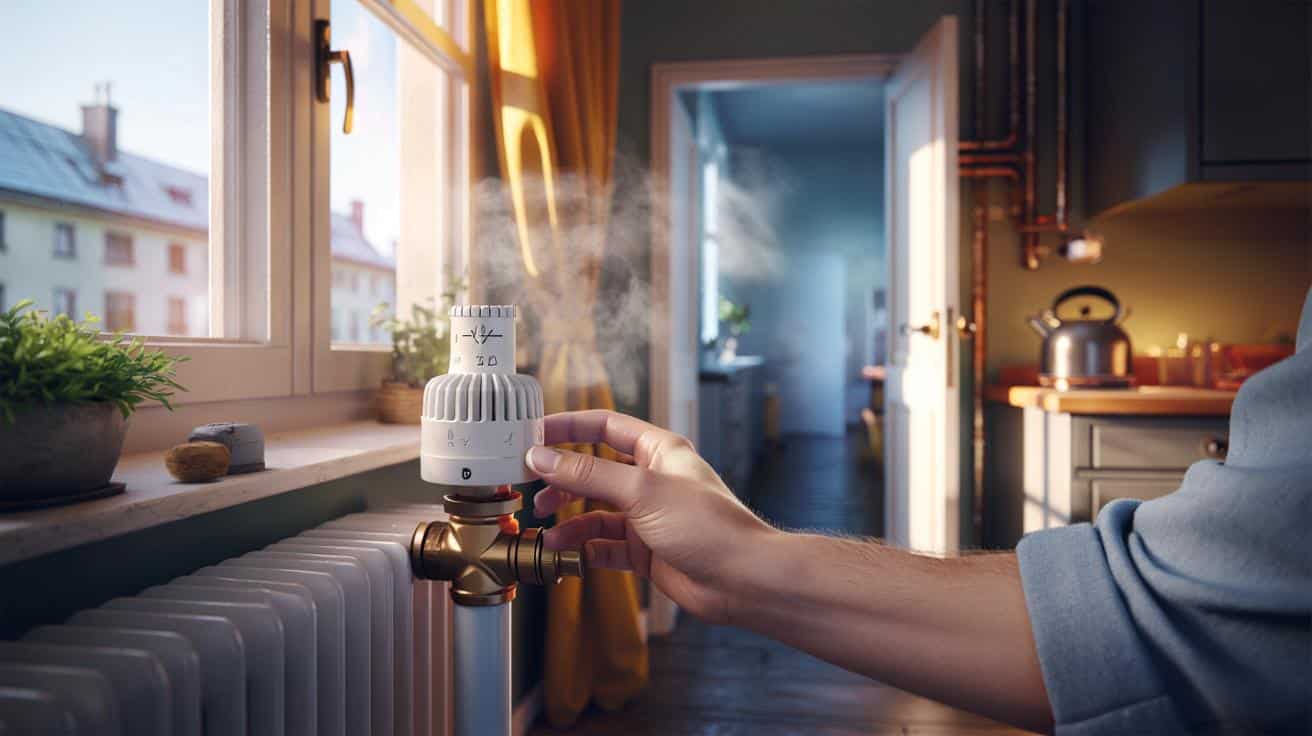
That “3” is not a universal comfort badge. On most valvole termostatiche, it roughly aims near 20°C, but only if the head senses clean room air and the radiator’s niche isn’t a heat cave. Different brands map numbers differently. A south-facing living room at “3” after lunch sun is not the same “3” in a shaded bedroom at 7 a.m. Curtains, drafts, and furniture rewrite the physics. “3” is not a temperature; it’s a relative position on a spring and wax capsule trying to read your room.
Take a typical 80 m² flat in Bologna. The owner left every valve at 3, day and night. A small logger on the shelf showed 1.5°C swings during cloudy afternoons, then a late-night overshoot when neighbors’ heat bled through walls. Gas use stayed stubborn. After a week of room-by-room tuning—kitchen at 2.5, hallway at 1.5 to encourage flow, bedrooms at 2 by night—the same home saw steadier temperatures and a 12–18% drop in burner hours. That’s not a lab fairy tale. It’s how feedback loops behave in messy rooms.
Here’s the logic. A thermostatic head only “knows” the air right around it. If it’s tucked behind a curtain, it thinks the room is hot and throttles down early. If a draft kisses the head, it thinks the room is cold and overfeeds. When you leave everything at 3, you lock in those local biases. Your boiler then short-cycles as multiple rooms slam valves shut at once, pushing return temperatures up and killing condensing efficiency. On a mild day, that can mean paying more to feel less warm. The number looks calm; the system isn’t.
Do it right: set, test, and season-proof your valves
Try a small routine. Pick one room. Place a simple thermometer at chest height, away from the radiator. Start the valve fully open for a short warm-up. When the room hits your target—19–21°C for living areas, 17–19°C for bedrooms—dial the head down in tiny steps until the radiator starts to cool. Note the number with a pencil tick. Start high for 30 minutes, then nudge down until the room sits where your body smiles. Repeat another day at a different outside temperature. Two notes on a sticky tab beat one guess in winter.
Keep a few guardrails. Don’t smother a valve with a heavy curtain or a sofa arm. Leave at least one radiator freely flowing so the boiler always has a path. If you air a room, turn the valve down for that window-left-open moment, then back up; many heads have a snowflake setting for frost-protect when you’re away. Set bedrooms lower by night, living spaces lower when empty. Let’s be honest: nobody really does that every day. Build it into your weekly rhythm and you’ll still win. Heating faster by turning the valve to 5 is a myth; it only raises the maximum, not the speed.
Listen to the system, literally. If your boiler fires on-off-on-off every few minutes, spread your settings: open cooler rooms a bit, nudge warmer ones down, and lower the boiler flow temperature toward 55–60°C to help it condense. Small changes in three rooms can tame the whole house.
“Treat the valve numbers as hints, not orders,” says Luca, a heating tech who’s seen more sticky heads than loose screws. “Rooms talk. Your job is to hear them in five minutes, not five bills later.”
- Feel the pipes: a too-hot return means poor condensing and wasted savings.
- Check the head’s position: free air, not trapped under curtains or shelves.
- Balance the system: don’t shut half the home; keep flow alive somewhere.
- Mark your sweet spots with a pencil. Future-you will thank you.
- Once a month in summer, twist each valve end-to-end to prevent sticking.
What this changes for your comfort and bill
When you stop treating “3” like a sacred setting, rooms find their own quiet. The hallway stops hoarding heat that should travel to the study. The boiler breathes slower, longer, and cooler, which is exactly where a condensing unit saves real euros. You start seeing 0.3–0.6°C swings instead of 1–2°C spikes. That steadiness feels like a thicker sweater on the building itself. And it lowers noise—the clicks, the sudden rushes, that restless hum.
The shift isn’t dramatic. It’s a handful of careful minutes, once per room, and a seasonal check when coats come out or tulips appear. Share your pencil marks with the family. Agree on a bedroom target that lets everyone sleep. Ask a friend to try one room and swap notes next week. This is home as a team sport, not a gadget arms race. You might even notice the kettle boils a little less often because you linger longer in a right-temperature kitchen.
There’s room for small joys. The radiator that used to scorch your calves now warms gently. The sofa corner stops feeling like a draft trap. And the bill looks a little kinder, not from sacrifice, but from sync. The valves didn’t change—your use did. That’s the quiet win that stays through winters to come.
| Point clé | Détail | Intérêt pour le lecteur |
|---|---|---|
| “3” isn’t a temperature | Numbers map differently by brand and are skewed by curtains, niches, and drafts | Avoids false comfort and uneven rooms |
| Calibrate room-by-room | Warm up, step down, note the sweet spot with a real thermometer | Faster comfort and measurable savings |
| Protect boiler efficiency | Prevent short-cycling; keep return temps lower; leave a flow path open | Lower bills without losing warmth |
FAQ :
- What does “3” actually mean on my thermostatic valve?It’s a relative position that roughly targets around 20°C at the head’s sensor in ideal conditions. In real rooms, it can mean 18°C or 22°C. Treat it as a starting point, not a promise.
- Should every room stay at the same number?No. Sunny rooms, kitchens, and hallways need different settings. Calibrate each space once, then keep a small seasonal tweak.
- Do TRVs still save money if I have a central thermostat?Yes. The thermostat sets the overall call for heat; TRVs fine-tune each room. Together they avoid overheating unused spaces.
- My boiler keeps clicking on and off—what can I change?Open at least one radiator more, lower too-warm rooms slightly, and drop boiler flow to 55–60°C. Look for blocked heads under curtains.
- How do I stop valves from sticking after summer?Once a month, spin each head from min to max and back. If one stays stuck, gently tap the body near the pin or call a tech.