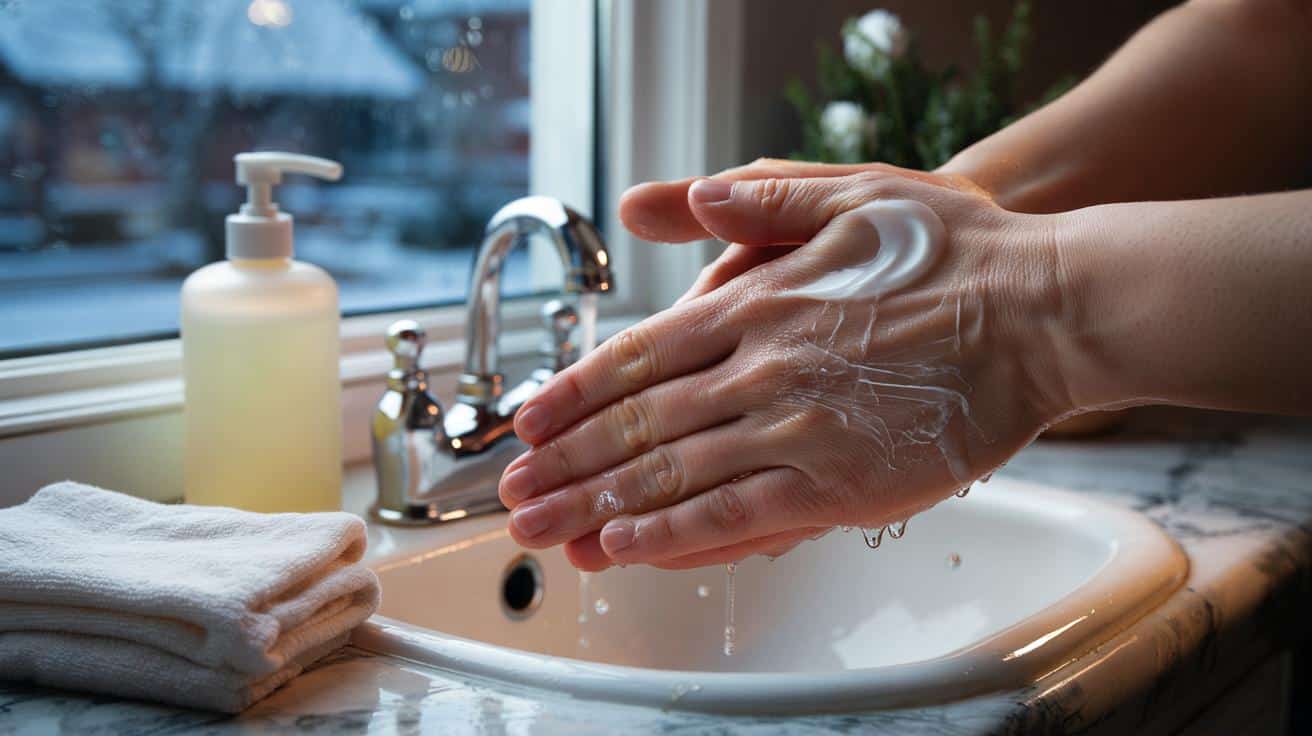
You rub in more cream, and then more again, yet the cracks keep returning. The reason feels counterintuitive: cream alone does little if your skin isn’t primed first.
It started with a handshake in a doorway, the kind you try to hide because the skin snags like paper. At the café till, a woman pulled a tube from her coat and massaged a glossy stripe into her hands, wincing as it burned for a second, then tucking the tube away like a ritual learned long ago. She would do the same two hours later, and again after washing the cups, and again before pulling on her bike gloves for the ride home. *What if the fix wasn’t in the tube at all, but in what happens right before it?* The trick starts before the tube opens.
Cold, cracked hands: why cream keeps failing you
Skin isn’t a sponge; it’s a wall. Think bricks and mortar: the bricks are your skin cells, the mortar is a blend of fats that lock moisture in. In winter, that mortar thins out, hot water melts it, and harsh soap strips what’s left. When you drop cream onto bone-dry skin, it often just sits there, like trying to seal an empty jar.
Ask anyone who works outside and they’ll show you the cycle: wash, sting, cream, relief, repeat. A delivery driver told me his hands improved only when he changed the order—water first, then cream—after a GP mentioned it in passing. Dermatology clinics report winter spikes in hand dermatitis; the pattern mirrors colder air, indoor heating, frequent washing. The numbers vary by country, but the story repeats on every street.
Here’s the logic. Humectants like glycerin or urea pull water into skin, but they need… water. Occlusives like petrolatum trap it in, but they can’t trap what isn’t there. Surfactants in foaming washes raise pH and lift away protective lipids, while scalding water melts them faster. So the sequence matters: rehydrate the surface, then seal, and avoid stripping between rounds.
Do this first: prime with water, then seal the barrier
Adopt the 30‑second ritual. Rinse hands with lukewarm water for a slow count of ten, then pat—not rub—so they’re still lightly damp. Slide on a thin layer of a humectant-rich product (a drop of glycerin, a urea lotion, or even a hydrating mist works), and immediately follow with a thick cream. Finish with a fingertip of ointment over the knuckles and cuticles. This is **the 30‑second rule**.
Small swaps ease the grind. Switch from foaming, scented soap to a syndet or creamy cleanser; keep water warm, not hot; let hands air-dry a few seconds before patting. If sanitizer is non-negotiable, pick one with added emollients and treat it like a pre-cream moment—once it dries, apply. At night, apply on damp skin, then pull on cotton gloves for 20 minutes, or sleep in them if you can. Let’s be honest: nobody really does this every day. But every time you do, you bank comfort for later.
There’s a phrase nurses use during winter shifts: hydrate, then occlude. It’s unglamorous, and it works.
“Cream on dry hands is like rain on a tarp. Put water underneath—then your cream has a job.” — Mara C., community nurse
- Keep a travel-size hydrating mist or rinse with water before cream.
- Choose fragrance-free formulas with glycerin, urea, ceramides, petrolatum, or dimethicone.
- Use the knuckle-ointment trick: a pea-sized dab across the back of each hand.
- Night reset: dampen, cream, then cotton gloves 20–30 minutes.
- Gentle wash routine: lukewarm water, low-foam cleanser, short contact time.
The habit your hands will actually keep
We’ve all had that moment when the steering wheel feels like sandpaper against cracked knuckles, and the thought of another pump of perfumed lotion makes you wince. The ritual that sticks is short, repeatable, and forgives missed days: a little water, then cream, then a thin seal—done. If you thread that tiny sequence through your day, after washing up at the sink or stepping off a train, the relief stacks quietly until the cracks stop opening.
What changes most isn’t the product line-up, it’s the choreography. You go gentler on heat and soap. You treat sanitizer as a cue, not a culprit. You apply on damp skin, not as an afterthought in a dry draft by the door. One minute, a soft towel, a small drop of glycerin, a blob of cream, a breath of ointment over the sore places. **Apply on damp skin** becomes muscle memory. And that’s when winter loosens its grip.
Cold doesn’t negotiate, but routines do. Maybe your fix is a bottle by the kitchen sink, a pocket-sized mist next to your travel pass, or a glove ritual by the bedside. If someone you love is forever rubbing their hands together like they’re trying to start a fire, this is the kind of tip that travels well. Share it, tweak it, revisit it when radiators click on. **Barrier before beauty**, every time.
| Point clé | Détail | Intérêt pour le lecteur |
|---|---|---|
| Prime with water | Rinse or mist, pat to damp, then cream within 30 seconds | Turns any cream into a true moisture lock |
| Gentle cleansing | Low‑foam syndet, lukewarm water, short contact time | Prevents daily lipid loss that fuels cracking |
| Night occlusion | Apply on damp skin, cotton gloves 20–30 minutes | Quick recovery boost without daytime fuss |
FAQ :
- Does hand cream work if my hands are already dry?Cream helps a little, but it works far better when applied on damp skin. Add water first, then seal it in.
- What ingredients actually heal cracked hands?Look for glycerin, urea (5–10%), ceramides, petrolatum, shea butter, and dimethicone. They hydrate, rebuild the “mortar,” and lock it down.
- How often should I reapply in winter?Each time you wash or sanitize is a cue. Even two to three good rounds a day make a difference if you prime with water first.
- Are hand dryers and hot water making it worse?Yes. Heat melts lipids and speeds water loss. Use lukewarm water and pat dry; paper towels or cool air are kinder than hot blasts.
- When should I see a professional?If cracks bleed, itch keeps you up, or you see signs of infection, book a visit. Prescription-strength repair may be needed.