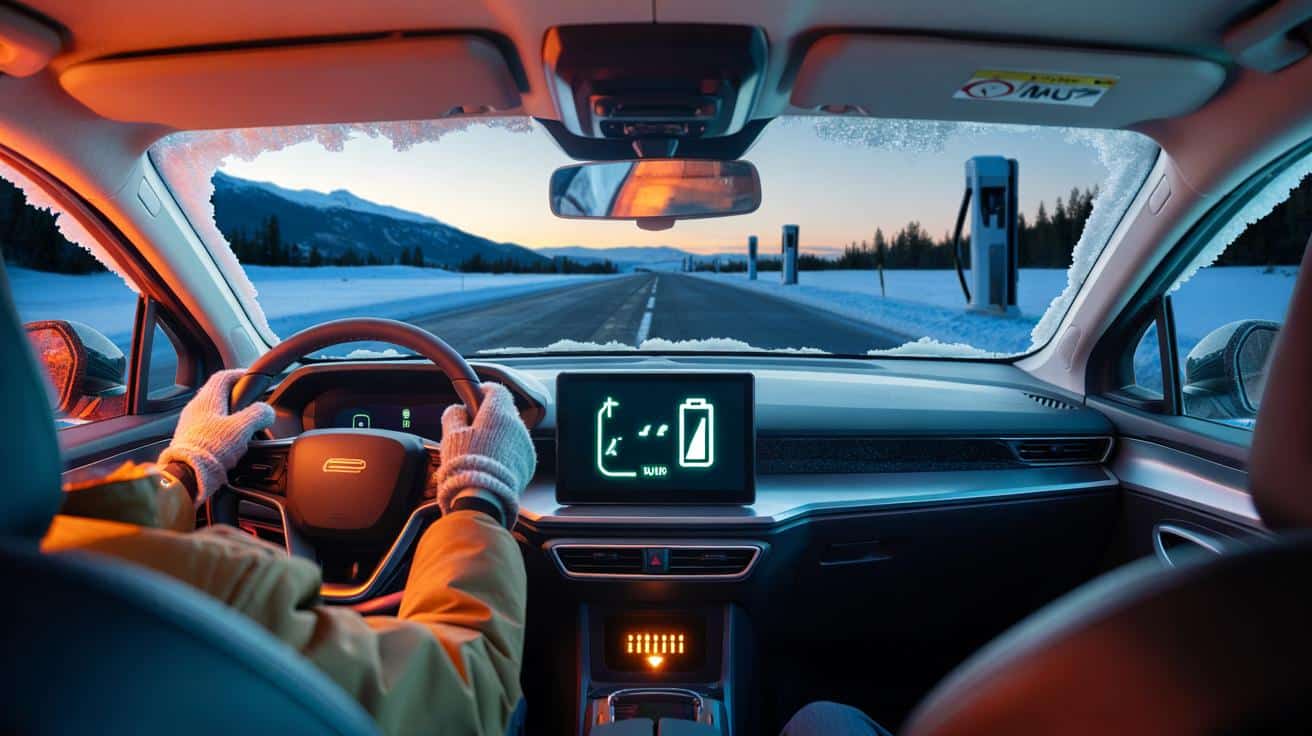
On cold mornings, EV drivers face the same quiet drama: defrost the windshield, turn up the heat, watch the range estimate dip. The fear is simple and practical — will the battery hold up with the cabin toasty? Real-world data from Europe and the U.S. draws a clearer line than guesswork. And the answer isn’t just about temperature. It’s about what you do with that warmth.
You thumb the app, start preheating, and the car comes alive with a soft whir as the cabin fog melts. By the time you step outside, breath turning to smoke, the range number on the dash has changed — not catastrophically, but enough to make you pay attention. On a short commute, it’s background noise; on a day trip, it’s a variable that can tug at your shoulders. Some days you feel it more than others. What’s the real cost of warmth?
What the numbers really say in winter
On paper, heating feels like a small thing; in reality, it’s the biggest winter variable you can control. Multiple test sets line up: at 20°F (−6°C), AAA measured range losses of about 41% with the heater on, and around 12% with it off. Norway’s massive NAF winter test finds an average drop close to 20% across models, with outliers past 30%. Recurrent’s U.S. fleet data adds context: mild cold trims 5–15%, deep cold bites harder. Heat pumps consistently cut the pain, while old-school resistive heaters drink energy fast. That’s the headline you feel in your toes. The rest is chemistry and physics doing their quiet winter thing.
Picture a mid-range EV driving from Turin to Aosta at 0°C. Cabin set to 20°C, heat pump engaged, two people inside, a bit of highway, a bit of climb. The climate system cycles between 1–2.5 kW once the cabin is warm; on long stints, the car loses roughly 10–18% versus the same route in spring. Crank a resistive heater to 22–23°C and hold it there, and you’ll see 3–5 kW spikes that nibble 25–35% off your expected reach. AAA’s lab confirms the direction, NAF makes it feel human, and owner logs fill in the messy lines between.
Why the drop? Dense cold air thickens aerodynamic drag and adds a few percent by itself. Winter tires and stiff rubber raise rolling resistance. The battery’s internal resistance rises in the cold, trimming efficiency and limiting regen, so more energy is needed to move and to heat. Cabin warmth is the knob you twist every minute, so it becomes the story you notice. *Cold isn’t the enemy; unpredictability is.* Get the thermal system stable, and the loss becomes steady and predictable instead of spiky and stressful.
How to keep range without freezing
Start warm, stay warm. Preheat while plugged in, even for 10 minutes, and target the battery as well as the cabin through the car’s navigation to a charger. Set cabin to 19–20°C and use seat and wheel heaters — they sip 50–100 W each and feel instant. Recirculation helps once windows are clear. On the road, a small temperature nudge down saves more than you think, and cruise at a calm speed trims drag dramatically. These are not hacks; they’re gentle levers that stack.
We’ve all had that moment when the windshield fogs at a stoplight and panic taps the demister. Use short bursts of defog plus low fan, not full blast for ten minutes. Keep tires at proper winter pressure — you lose about 1 psi for every 10°F drop — and don’t carry a ski shop in your trunk. Let regen warm the pack in traffic before the highway if you can. Let’s be honest: nobody really does that every day. Do the two or three easy things you’ll actually repeat, and winter range stops feeling like roulette.
You don’t need to become a monk of kilowatts to feel the difference.
“Heat the human, not the whole house,” an Oslo taxi driver told me after 300,000 km in a Model 3. “Seat heat on, cabin modest, and I stop thinking about it.”
Here’s a simple winter checklist that works in any EV:
- Preheat while plugged in, especially before highway legs.
- Favor seat and wheel heaters; set cabin to 19–20°C.
- Use recirculation once windows are clear to hold warmth.
- Plan chargers on uphill routes; navigate to precondition.
- Keep speed smooth; small lifts save big watts.
A wider look: winter changes habits, not destinies
Cold doesn’t turn an EV into a different car; it magnifies the choices you make. Data shows that the heater is the range lever you feel first, but the backdrop is consistent: air, rubber, chemistry, and hills. A heat pump narrows the gap; gentle speeds and preconditioning do the rest. That’s why northern fleets adapt quickly — the routine becomes muscle memory, and the worry fades. Your winter radius may shrink 10–30% on a given day, then bounce back at lunch when the sun hits, then change again with a tailwind. The trick is to turn a fluctuating number into a predictable habit. Once you do, the cold becomes just another filter on the map, not a limit on your plans.
| Point clé | Détail | Intérêt pour le lecteur |
|---|---|---|
| Heater impact | Up to ~41% loss at 20°F with cabin heat; ~10–20% typical in real-world | Sets realistic expectations for winter trips |
| Heat pump advantage | 1–2.5 kW steady draw vs 3–5 kW spikes with resistive heaters | Shows why certain trims feel better in cold |
| Practical levers | Preheat plugged in, use seat/wheel heat, keep 19–20°C, plan chargers | Immediate, measurable gains without discomfort |
FAQ :
- How much range do I lose with the heater on in winter?In deep cold around 20°F (−6°C), lab tests saw up to ~41% loss with the heater on. Many real-world drives sit closer to 15–25%, and mild cold trims 5–15%.
- Do heat pumps really help that much?Yes. They cut cabin heating power roughly in half once warm, smoothing draw to ~1–2.5 kW. That can mean dozens of extra kilometers on a long stint.
- Is preconditioning worth it if I’m only driving 15 minutes?It is if you’re plugged in. You start with a warm cabin and a battery ready for regen, which keeps short trips efficient and windows clear.
- What’s the most efficient way to stay warm?Set the cabin to 19–20°C, use seat and wheel heaters, and recirculate air after defogging. Small comfort tweaks beat blasting hot air for long stretches.
- Why does fast charging feel slower in the cold?Cold packs resist high current and limit regen. Navigate to the charger so the car warms the battery en route, then charging speeds ramp closer to the peak.