The real question isn’t “on or off?”, it’s “how much does a month of glow actually cost?”. If you’re picturing double‑digit euros for a small string of LEDs, you might be in for a gentle surprise.
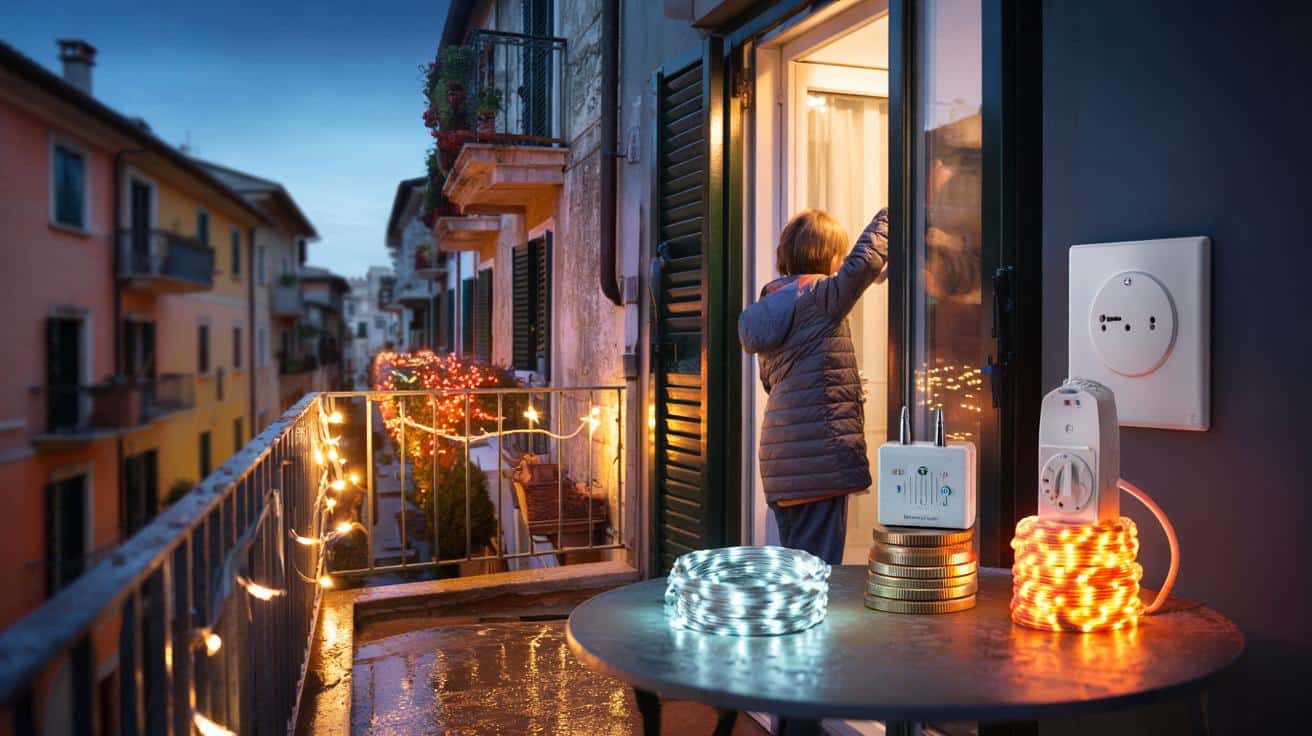
It’s a damp December dusk and the building across the street is waking up. One balcony blinks warm gold, another goes full candy cane. A kid in a puffy jacket points, the grown‑ups smile, and I notice the father glance toward his meter cupboard like it might bite. I’ve been that person, balancing sparkle against kilowatt‑hours, while the kettle whistles and the cat steals my chair. The ritual is always the same: plug in, step back, feel the lift, then wonder if the glow is quietly burning a hole in your budget. The math surprises.
How much does a month of balcony lights really cost?
Let’s anchor this in numbers, not fear. A typical LED string for outdoor use draws between 4 and 8 watts; a compact LED curtain or net might be 10 to 20 watts; a classic incandescent rope from the attic can gulp 80 to 200 watts. Run anything 8 hours a night for 30 days and you get 240 hours. Multiply watts by hours, divide by 1,000 to get kWh, and then multiply by your tariff. Many Italian households today pay roughly €0.22 to €0.40 per kWh, all-in. **For a month of LEDs, we’re talking coins, not notes.**
Take a 6 W LED string. 0.006 kW × 240 h = 1.44 kWh for the month. At €0.30/kWh that’s €0.43. Double it for two strings and you’re still under a euro. A 15 W LED net? 0.015 kW × 240 h = 3.6 kWh → ~€1.08. Now swap in an old 200 W incandescent rope you found in a plastic bin: 0.2 kW × 240 h = 48 kWh → ~€14.40. Same glow to your eye, wildly different to your bill. No drama, just numbers.
The spread comes from three levers: power draw, hours, and your tariff. LED tech converts energy to light with minimal heat loss, so it sips. Incandescent throws off heat you didn’t ask for and makes your meter spin. Hours matter just as much: an automatic timer that trims your nightly glow from 10 hours to 6 chops 40% of the consumption without dimming a single bulb. Tariff swings add spice—fixed vs variable contracts can shift the euro total by several percent—yet the hierarchy stays: small LED setups cost well under a cappuccino per month, big incandescent ropes hit “pizza and a drink”.
How to keep the magic and shrink the bill
Start with a 30‑second audit. Look at the label or product page for “W” or “W/m”. If it just says “LED” with no wattage, that’s not helpful; check the plug or driver for output. Aim for strings under 8 W, nets 10–20 W, rope lights 2–4 W per meter for dense sparkle, or 0.8–1.6 W per meter for softer lines. Plug everything into a mechanical or smart timer set for 17:00–23:00. **Timers are the cheapest energy tech you can buy.**
Skip overnight glow unless you’re hosting or your balcony faces a lively street. Your neighbors sleep, your power bill breathes. Choose warm white LEDs (2700–3000 K) for a cozy look that feels brighter at lower wattage because our eyes “accept” warm light as festive. Replace old incandescent leftovers; they waste energy and get hot near curtains. Let’s be honest: nobody tracks every kilowatt‑hour at home. So pick once, automate once, and forget it for the season.
We’ve all had that moment where the house is finally quiet and the lights make the room feel bigger than it is. That’s the point. Balance the feeling with a little math and you win twice.
“If you can read the wattage, you can read the bill,” my electrician friend Marco told me as we stood on a chilly landing, watching fairy lights blink. “LEDs are the closest thing to free light we’ve ever had.”
- Quick math: Cost = (Watts ÷ 1000) × 240 hours × your €/kWh
- Typical LED string: 6–10 W → ~€0.45–€0.72 per month at €0.30/kWh
- 10 m LED rope: 10–40 W → ~€0.72–€2.88 per month at €0.30/kWh
- Old 200 W rope: ~€14–€16 per month at €0.30/kWh
- Timer cut: 8 h → 6 h reduces cost by 25%
So what does a “real” balcony setup look like in euros?
Picture a small city balcony with a 10 m warm‑white rope (30 W), a star curtain (12 W), and one 6 W string around a planter. That’s 48 W total. Run 8 hours nightly for a month: 0.048 kW × 240 h = 11.52 kWh. At €0.28/kWh, you’re near €3.23. Trim to 6 hours with a timer and it drops to ~€2.42. Swap the rope for a low‑power 12 W strip and your month’s glow lands under €2. A smart plug or timer sips 0.3–1 W in standby, which adds €0.06–€0.20 for the month—noise, not the song. If you’re lighting a larger facade with three ropes at 40 W each, then yes, you’ll see €7–€9. The rule is steady: the look you want is possible without spiking the bill.
| Point clé | Détail | Intérêt pour le lecteur |
|---|---|---|
| — | LED strings are usually 4–10 W | Expect cents, not euros, for a month |
| — | Timers cut hours by 25–40% | Immediate savings without changing the look |
| — | Old incandescent ropes are 80–200 W | Biggest hidden drain, easy to replace |
FAQ :
- How much does a 10 m LED rope cost if I run it for a month?Check the wattage. At 20 W: 0.02 kW × 240 h = 4.8 kWh. At €0.30/kWh, about €1.44. At 40 W, double it to ~€2.88.
- Is battery power cheaper than plugging into the wall?Not really. AA batteries store pricey energy; you pay more per kWh than mains. Mains + timer is the budget route. Rechargeable packs can help if you need cordless, but they don’t beat grid cost.
- Do solar fairy lights work in winter on a balcony?They light up, but runtime is short on cloudy days and north‑facing balconies. Fine for a soft accent, not a bright statement. Place the panel in the sunniest spot you have.
- Should I switch off at night or leave a dim mode?Switch off. Six hours of glow hits the festive nerve. Overnight mostly wastes watts and sleep. Use a timer so you never think about it.
- Are smart plugs worth it for Christmas lights?Yes if you like schedules and voice control. Standby draw is tiny. For pure savings, a €5 mechanical timer does the same job and never crashes.